The Best Brand Strategy Usually Starts Somewhere Unpolished
Last Updated
September 28, 2026
It usually begins with a mess. Like actually.
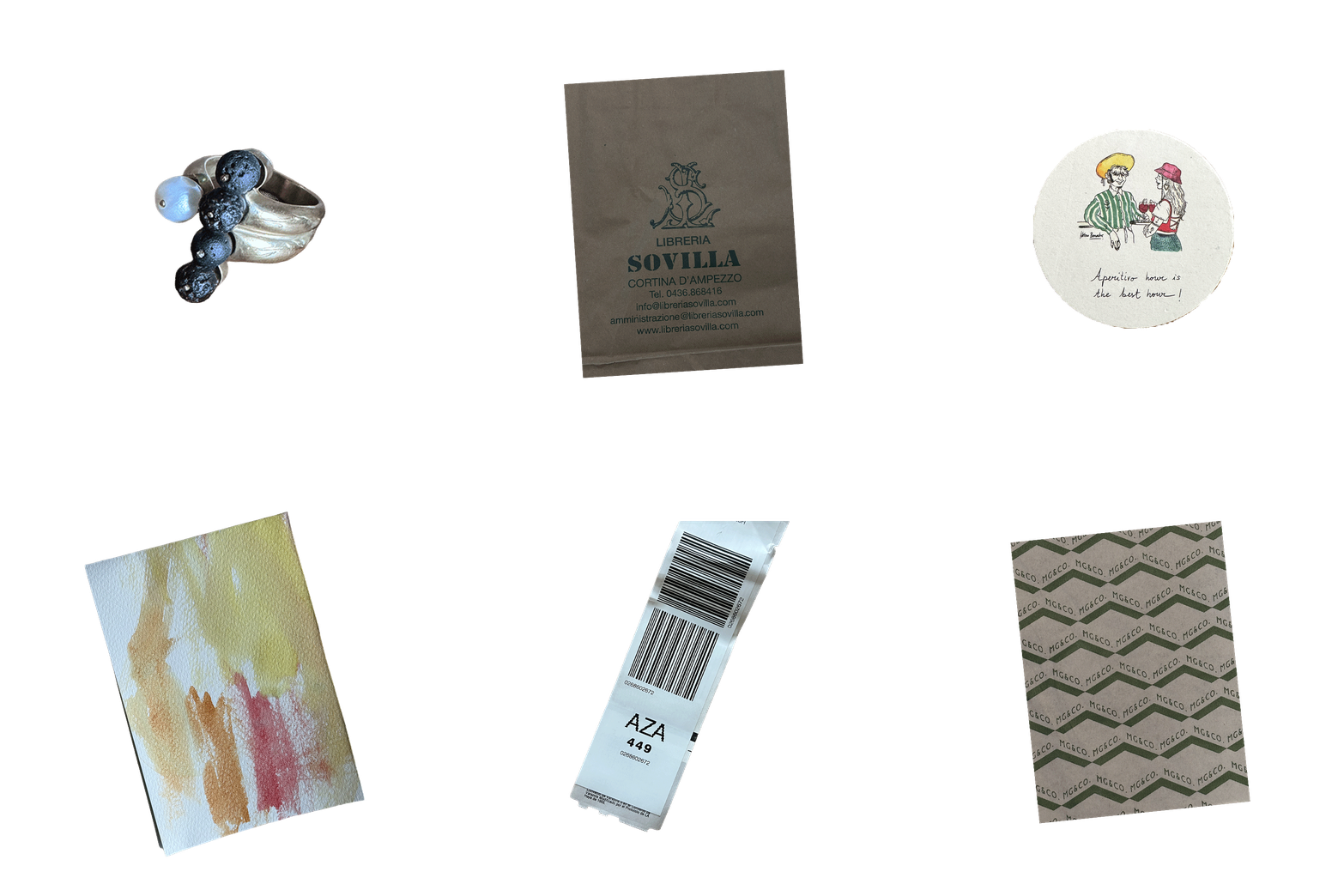
A notebook opened somewhere in the middle, a photograph pulled from an old folder, a sentence circled three times, a voice note recorded on the drive home, or seventeen screenshots that appear to have absolutely nothing to do with one another until someone starts explaining why each one mattered enough to save.
And then someone tells a story they almost didn’t tell.
That’s usually when things get interesting.
There is something incredibly revealing about what people keep. The image they’ve saved for years. The phrase they can still hear in a parent’s voice. The restaurant they somehow reference in every creative conversation. The tiny frustration they experienced often enough that one day they decided to build a company around fixing it.
Memory leaves fingerprints, and more often than you’d think, those fingerprints become the beginning of a brand.
Discovery is the work.
Meaningful discovery isn’t a questionnaire we send before the real work begins. It is the real work.
It’s sitting across from someone and listening closely enough to notice when the conversation changes. A question about the audience somehow becomes a story about childhood. A conversation about product reveals a deeply held belief about care. A reference shared because someone “just likes the color” opens an entirely new emotional direction. A founder says something casually that everyone else in the room immediately writes down.
At ENC, those are the moments we’re listening for: the story told twice, the phrase that keeps resurfacing, the answer that suddenly gets longer, or the moment someone stops explaining what the company does and starts talking about why it matters.
That is often where the strategy finds its spine.
We want the rambling answer.
We want the story behind the story. We want the reference that feels too personal, the photograph you’re not sure belongs in a brand conversation, the magazine you loved 15 years ago, the hotel lobby you still think about, the family tradition, the strange obsession and the thing you absolutely do not want your brand to become.
The most valuable material often lives in the overlap.
Maybe a founder is drawn to the hospitality of an old neighborhood restaurant, the restraint of a fashion house, the warmth of a family tradition and the irreverence of a magazine they loved growing up.
On paper, that might look like a fairly chaotic moodboard. Together, it begins to reveal a sensibility. Strategy is the work of recognizing that pattern. It takes everything someone has been feeling intuitively and begins to give it language, structure and direction. By the time the final strategy is presented, the answer can feel almost obvious. That’s usually a good sign.
It just didn’t start that way.
Naming rarely starts with a thesaurus.
The strongest names often begin somewhere much more interesting: a behavior, a belief, a family history, a cultural reference, a childhood nickname or a phrase someone has been saying for years without realizing there might be an entire brand hiding inside it.
This is why we’re usually less interested in starting with “What words describe your product?” and much more interested in “What world does this belong to?”
A surname can carry more meaning than 100 invented words. A childhood expression can hold exactly the warmth we’ve been trying to manufacture. An offhand comment can reveal an attitude that belongs naturally to the business.
The best names often feel less like they were assembled and more like they were found, even when they’re entirely new.
Messaging gives instinct a vocabulary.
Founders often know exactly what their brand is before they know how to say it.
The first answer usually explains the product. The second explains the benefit. Keep going and eventually you reach something else: the belief.
Why this needed to exist. Why they couldn’t stop thinking about it. Why the alternative never felt good enough. Why someone should care beyond the features printed on the box. That’s where messaging starts becoming more than copy. People can feel the difference between language designed to sound impressive and language rooted in something true. One fills space. The other creates recognition.
Creative direction starts long before we open a design file.
Before typography, color or the logo, there is a world we’re trying to understand.
Sometimes a faded family photograph tells us more about the palette than a color exercise ever could. An old storefront unlocks something about typography. A hotel lobby tells us how the brand should make someone feel. A film reference isn’t actually about the clothes or the setting, but about the quality of the light.
Sometimes what matters is the intimacy of a crop, the imperfection of a material, or the tension between something incredibly refined and something slightly undone. Creative direction is figuring out what underneath the reference is actually resonating and translating that emotional principle into something entirely its own.
That’s how you build a visual world with memory in it.
Campaigns need something human at the center.
The campaigns we remember usually begin with something specific: a familiar phrase, a personal habit, a cultural memory, or a tiny behavior everyone recognizes but nobody has bothered naming yet.
That detail becomes the way in.
Because a campaign can simply announce a product, or it can give people a feeling, a conversation, an inside joke, a reason to participate or a world they want to enter. The strategy creates the focus and the creative execution gives it dimension. Together, they turn a collection of deliverables into a point of view in motion.
This is what we mean.
We see this happen constantly inside ENC projects.
A founder comes into a strategy session believing they need to tell us about their customer, product, competition and goals. And yes, we need all of that.
But then they tell us something else.
Maybe it’s a story about their grandmother, a phrase they wrote in a journal years before the company existed, a ritual they have never thought of as particularly meaningful, a frustration from their own life that turns out to explain exactly why the product needed to exist, or a reference they preface with:
“This probably makes no sense, but...”
Our favorite sentence, by the way.
Because sometimes that becomes the thing.
It becomes the founder story, the positioning, the name, the campaign or the sentence everyone remembers. Not because we forced meaning onto a random detail, but because the meaning was already there.
Our job was to notice it.
A real ENC example belongs here.
I think there is an opportunity to bring one specific project into this story without turning the piece into a formal case study.
Something as simple as:
A founder came to us with [the raw thing: journal entry / family story / personal frustration / photograph / phrase].At first, it seemed like a small piece of the larger discovery conversation. But as we kept returning to it, we realized it held [the larger tension or belief].
That insight eventually became [the name / positioning / messaging / creative direction / campaign]. What started as something deeply personal and seemingly incidental became the thread connecting the larger brand.
That is exactly the kind of transformation we mean when we talk about discovery.
The polish comes later.
Eventually, the scattered pieces start speaking to one another.
The notebook page connects to the photograph. The family story connects to the customer need. The offhand phrase connects to the name. The visual reference connects to the campaign.
What once looked like a pile of scraps starts becoming a system. The language settles, the references sharpen, the strategy holds and the design begins. Eventually everyone sees the beautiful presentation, the polished website, the campaign, the packaging and the brand fully alive in the world.
What they usually don’t see is the table underneath it all: the crossed-out notes, the 47 screenshots, the voice memo, the old photograph, the weird reference or the story someone almost decided wasn’t worth telling.
A polished brand rarely begins polished.
It begins as instinct, memory, experience, taste, frustration, contradiction and a collection of half-formed thoughts with enough life inside them to lead somewhere.
At ENC, we don’t begin by asking a brand to have all the answers. We begin with what’s already there. We listen for what carries weight, follow the strange little threads and ask another question when something feels interesting.
And then another.
Until all those seemingly disconnected pieces start revealing something that was there all along: the clearest, most honest and most ownable version of the brand itself.
The polished part comes later.
The messy part? That’s usually where the magic is.






















.png)