Apparently, No One Wants to Be Different Anymore
Last Updated
September 30, 2026
Sameness isn't an accident. It's a decision, made a thousand small times, by people who were too scared, too tired, or too rushed to ask a harder question first. Lemme break that down a bit more so you can see what I am seeing.
I keep walking into rooms. All kinds of room. Rooms like coffee shops, gyms, clothing stores, brand meetings, Instagram feeds and they all look like the same room. How about you?
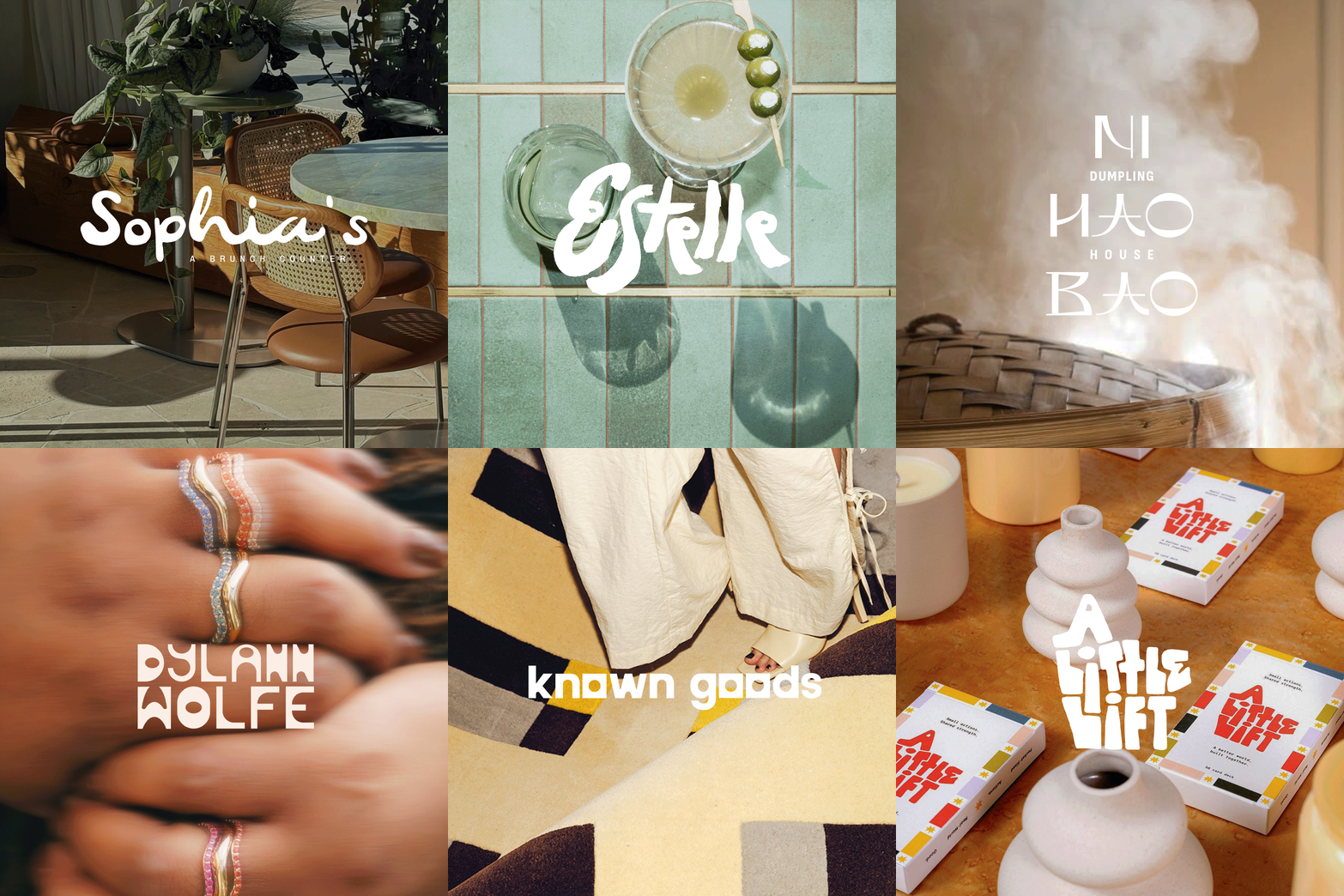
All of them seem to have that same raw wood counter, off-white walls, plants (real or fake), and of course that one 'moment' for everyone to share. Somehow, there was the discount on that one thick sans-serif logo in lowercase that everyone seems to have snatched up as well as a muted terracotta or sage accent color nobody can quite name, but it seems to be just enough personality to bring the brand to life. It doesn't matter if I'm in Phoenix or Lisbon or doing a doom scroll at midnight, it's the same room. And I've started to wonder if we've collectively lost the plot on what a brand is even for.
I see it constantly in my work, let me set the scene. A founder comes in with a moodboard full of brands they love and they know why they love each one, they've done their research. There's the ease of one, the grit of another and the elevated luxury of the third. Side question: what is elevated luxury? Apparently, everyone wants it, and no one can tell me what that is, perhaps that's another article. Once they share their inspiration, they open the conversation with "we want to feel like them." Not "here's who we are," but who they want to be like. Red flag alert, that's the tell.
I don't think I have to elaborate, but I will. That's the whole problem, sitting right there in the first five minutes of the brief. In business, and really anything, wanting to feel like something isn't a strategy. It's a costume (the colors, the fonts, the photos, the feed) you put on to convince everyone, including yourself, that you are that feeling. However, at the end of the day, it all comes off.
There's an old art experiment worth knowing. Let's get a little academic here. In the 1990s, conceptual artists Vitaly Komar and Alexander Melamid, used market research, focus groups, and polls to determine a nation's "most wanted" and "least wanted" paintings. They surveyed thousands of people across more than a dozen countries, asking about favorite colors, favorite subjects, what they wanted to see in a painting. Then they used the data to paint exactly what people said they wanted. The results, shown together as "The People's Choice," turned out to be nearly the same painting every time: a blue landscape, some water, a few animals, a historical figure standing around looking wise. Country after country, the "most wanted" painting was almost identical. The key takeaway is that if you average enough opinions, you don't get brilliance, you get beige.
That's what's happening to brands right now, except the survey never stops. Rather we are fed reference points every few seconds, all day, on every platform, and we absorb them whether we mean to or not. The writer Kyle Chayka has spent years naming this, he calls it "Filterworld," the flattening of taste that happens when everyone is fed from the same algorithmic trough. He noticed it first in coffee shops (remember when I mentioned coffee shops just a few paragraphs up?): exposed brick, hanging bulbs, a chalkboard menu, showing up in Nairobi and Portland and Seoul, in cafes that had never met each other but arrived at the exact same aesthetic because they were all optimizing for the same scroll.
Brands are doing this too, and it's rarely the obvious kind of copying. It's subtler. It's a founder who spends eighteen months immersed in someone else's brand decks, other people's feeds, other people's "aesthetic," and comes out the other side fluent in everyone's visual language except their own. By the time they sit down to build something, they're not starting from their own story. They're starting from an average of everyone else's. A brand's entire job is to be a specific, recognizable, have an irreplaceable point of view yet the moment you build from "what does everyone like" instead of "what are we," you've already lost the thing that made it worth building in the first place.
But, and I want to be completely honest about the other failure mode too, because I watch brands fall into this one just as often... being different for the sake of being different isn't the fix either.
Jaguar found that out in real time, anyone else love a Jag? Just me, no worries I'll catch you up. In late 2024, the storied British carmaker unveiled a bold new identity: a stripped-down logo, a "Copy Nothing" tagline, and a launch campaign that didn't feature a single car. All it had was abstract visuals and models in bright, editorial outfits. It was undeniably different from anything else in the category, and it also set off one of the fiercest brand backlashes in recent memory, because the boldness wasn't rooted in anything customers recognized as Jaguar. Longtime fans felt like decades of heritage had been erased instead of reinterpreted, and "different" started to look less like confidence and more like an identity crisis.
So here's what I actually believe, after fifteen years of sitting across the table from founders holding someone else's moodboard: the brands that last aren't chasing sameness, and they aren't chasing shock value either. They're the ones who did the unglamorous work first. Meaning, they figured out what is actually true about them before they ever even thought to opened Pinterest.
If you're building something right now and your inspiration folder is more developed than your point of view, that's worth sitting with because the brands people actually remember were never the ones that looked like everyone else's favorite thing. They were the ones brave enough to look like themselves, fully, before anyone told them that was allowed.
PRO TIP: Do the thing that makes you happy. The thing that makes you excited to share it before you've even finished making it. That's where industry defining moments are made.
I heard this put well on a recent episode of Rick Rubin's Tetragrammaton: ask someone what a hit song sounds like and their answer is likely going to be reminiscent of the sound of what has already worked. Meaning, if you build from that place, you're only making an echo of something that used to be popular. But if you build from what actually thrills you, it has a real shot at being new.
That's the only kind of "different" that holds up.
Your gut doesn't have historical data. It just has you. Start there.













.png)